What is Food Insecurity?

A food-insecure household means that members of the home don’t have access to enough healthy and nutritious food to support an active and healthy lifestyle.
Homes that have low food security must often make tough choices about the amount and quality of food they are able to provide their families. Homes that are considered to have “very low” food security often miss meals.
Hunger In America
Even in the world’s greatest food-producing nation, children and adults face poverty and hunger in every county across America. In 2017:
- 40 million people struggle with hunger in the United States, including more than 12 million children.
- A household that is food insecure has limited or uncertain access to enough food to support a healthy life.
- Households with children were more likely to be food insecure than those without children
- 58% of food-insecure households participated in at least one of the major federal food assistance program — the Supplemental Nutrition Assistance Program (SNAP, formerly Food Stamps); the National School Lunch Program and the Special Supplemental Nutrition Program for Women, Infants and Children (often called WIC)
Hunger In North Carolina
Every night, people in almost 630,000 North Carolina households don’t have enough to eat. North Carolina has the 8th highest rate of food insecurity in the nation.
- 1 in 6 people in southeast North Carolina are food insecure – 1 in 4 are children.
- 75% of North Carolina food bank clients have had to choose between paying rent or buying food.
- Southeast North Carolina has a food insecurity rate of 19%, much higher than the state average of 15.4%.
- Charitable programs are unable to fully support those struggling with hunger. The combination of charity and government assistance programs are necessary to help bridge the meal gap.
The Difference Between a Food Bank and a Food Pantry
How Do Food Banks Work?
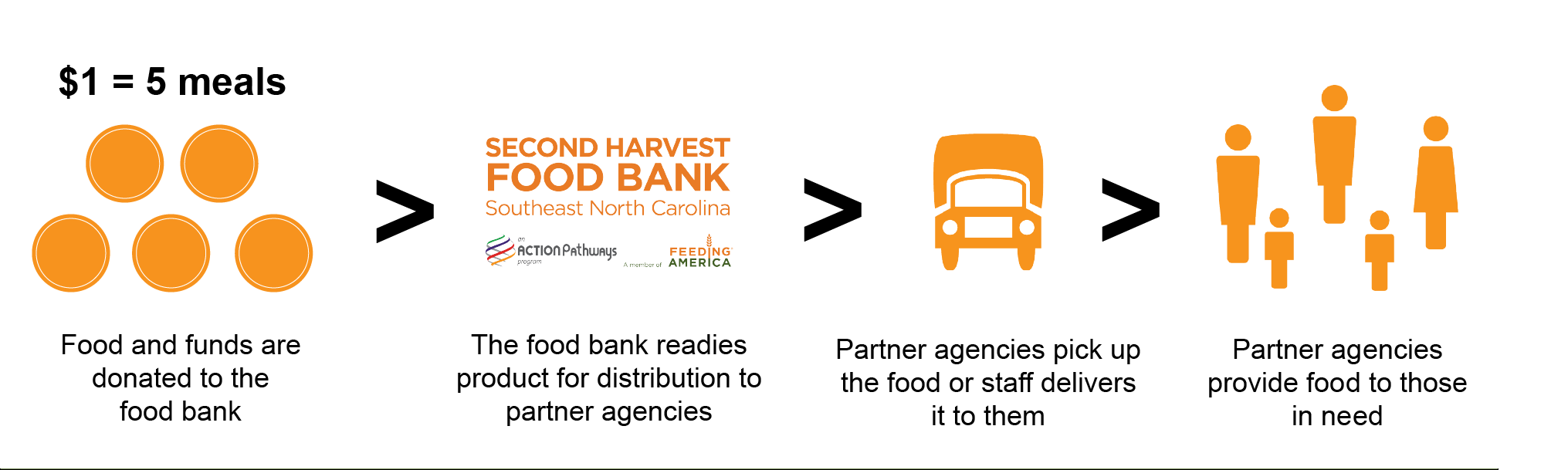
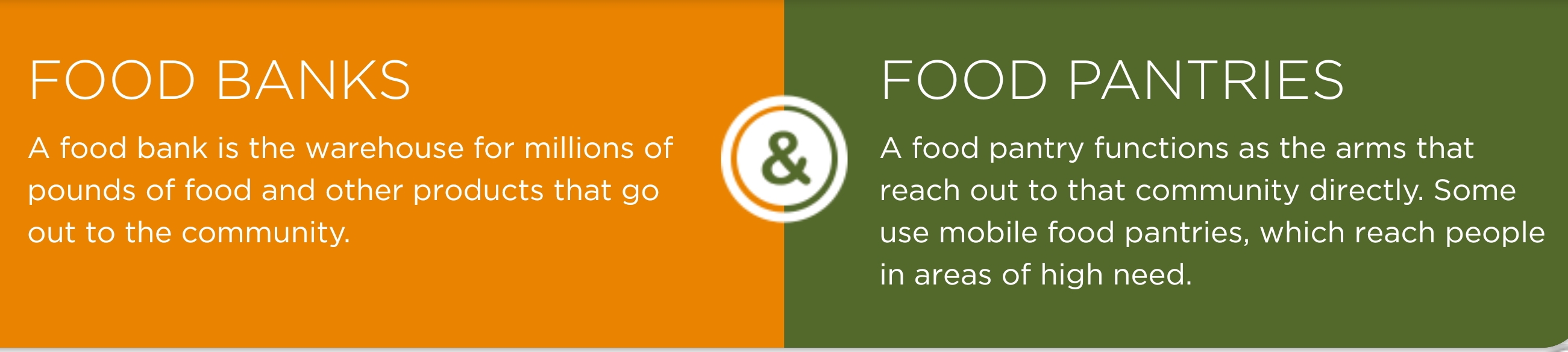
A food bank is a non-profit organization that collects and distributes food to hunger-relief charities. Food banks act as food storage and distribution depots for smaller front line agencies; and usually do not themselves give out food directly to people struggling with hunger.
Food banks in the U.S. are very diverse – from small operations serving people spread out across large rural areas to very large facilities that store and distribute many millions of pounds of food each year, and everything in between. A variety of factors impact how food banks work, from the size of the facility to the number of staff members. But, one thing all food banks have in common is that they rely on donors and volunteers to carry out their day-to-day operations.
[Speaker 1]
The Holy Family Food Pantry has been around for a little over 20 years. I have many stories of families that come through the food pantry, and the stories are just overwhelming at times.
[Speaker 2]
I was basically down on my luck. I couldn’t work. I was pregnant at the time, and I had two other girls besides Dad, so I started coming to the pantry, but I was very hesitant, basically because of pride.
I wanted to do everything on my own. I didn’t think I needed help from anywhere else.
[Speaker 3]
It cost me about $85,000 to fight for custody of my two children. Whatever was coming out of my job, I had to pay lawyers. Of course, it was not very easy because there was no money there, but I had to fight.
I had to fight to get custody, sole custody of the children. That’s why I ended up almost in the street.
[Speaker 4]
I had a fall and cracked a rib and did something to my knee, besides a lot of arthritis, and that did force me to give up my job because I couldn’t stand there and take care of the customers the way I should have.
[Speaker 5]
A lot of money in the medicine, $200, $100, $25, they lost everything, the house, everything.
[Speaker 1]
No one knows what kind of a situation they’ll be in in the future. You have no idea who’s going to come through that door. I have had people that have been on the giving side, now are on the receiving side.
[Speaker 6]
The partnership that we have with Feeding America and the Northern Illinois Food Bank is very important to our food pantry. It lets donors know that they can trust our organization, that their dollars are going to go very far. We can purchase a lot of food because of the partnerships that we have.
[Speaker 3]
For me to tell the children, we don’t have food, just plain to them, you know, why don’t we have food? Everybody else does. It hurts still.
It’s very difficult, very, very hard.
[Speaker 1]
There are definitely people from affluent communities that are struggling that need to have food also, and that to me is the most dramatic change that I’ve seen over my experience here at the food pantry.
[Speaker 7]
Well, we’ve had a lot of bad luck in the last five years, lots of it. My husband made good money. He had two car accidents, neither one his fault, totaled his truck.
Had to have 23 teeth pulled, diabetes, quadruple heart bypass. His medication is, he takes nine in the morning and eight at night, three of them cost $111 a month. The only thing we’ve been able to keep current is our house payment.
[Speaker 6]
In the last year, we’ve seen a lot of new families, new faces coming in, people that had no idea what a food pantry was. They eventually used up all the resources that they had, used up credit cards, and then they reached out to someone who eventually directed them to the food pantries. It’s really hard for them to come in.
They’re not used to that. They’re not, they don’t feel that they are that statistic.
[Speaker 8]
I went through some hard times, and I thought I could tough things out myself, and things got worse and worse and worse, so finally I had foreclosure papers served on me, and I think a lot of people now that go through foreclosure, lose their jobs, they don’t know a place like this exists.
[Speaker 1]
The number of new families that keep coming into our pantry are tremendously high. We have about 240 families that we serve a week, and of those numbers, we have about 40 to 50 new families a week.
[Speaker 9]
I was in the hospital for like two weeks because I couldn’t breathe, and I had to go to the hospital so they could incubate me. Well, incubate is like put tubes down your throat and open up your lungs, and when I came back home, somebody had broken into my house, busted off my windows, took my kitchen sink, everything. So that’s why I’m here now, because my kids probably wouldn’t have anything to eat, they probably wouldn’t have any clothes to go to school, anything.
[Speaker 6]
Our budget doesn’t last as long as it used to. Our shelves are not stocked the way they used to all the time. We just can’t keep them stocked.
Most of the food that we get is from the Northern Illinois Food Bank, and I’d say about 90 percent of what we get is from the Northern Illinois Food Bank, and obviously serving the needs of the clients that come in would really suffer if we didn’t have that.
[Speaker 9]
There’s a lot of people out here that really, really need help, and the food pantry is important because you might be good today, and you don’t know what situation you might be in tomorrow. You might have a refrigerator full of food today, and tomorrow you might not have anything.
[Speaker 10]
I have a son, his name is Dylan, and he’s going to be three months the fourth of this month. It’s a hard time. My boyfriend is in employment right now, and it’s hard to buy food, but they’re so nice.
They help me a lot. They give us food. They help me with my baby.
[Speaker 1]
Seeing a smile or someone coming up and giving me a hug and say thank you, you know, you helped me, or just give a success story, and there are success stories in the pantry.
[Speaker 6]
It really is heartwarming when you see families come back that you’ve helped, and now they’re donors. That’s really, really nice. They actually tell you how much of a difference you made in their life, and you think, oh, I’m just giving them a box of food.
But sometimes it really is the only thing that they need to keep them going.
[Speaker 2]
They gave so much, and I wanted to give back to the community too, and let others know that there was a place where they could go.
[Speaker 1]
To continue to stay here and grow and feed more families, we need to continue to receive support from agencies. We need to continue to work closely with Northern Illinois and Feeding America.
[Speaker 9]
Everything, it seems like, is coming around, and this place is a lot of help.
[Speaker 3]
The food pantry really has helped me get up on my feet.
[Speaker 7]
We’re survivors. We’re going to make it with the help of the food bank. ♪♪